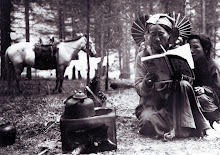
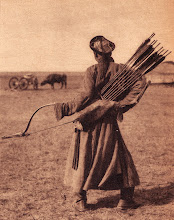
"Mongol Nomad Home" by Ts. Tsegmed
The Last Nomads: Photographs from Inner Mongolia by A Yin opens
Date: Friday, October 31, 2008
A Yin is a 2007 recipient of the All Roads Film and Photography Program award, sponsored by the National Geographic Society.
Exhibition runs through March 2, 2009.
The Wuzhu Muqin are the last remaining nomadic tribe in China, and have become Mongolian photographer A Yin’s source of inspiration. Yin has become his people’s advocate, exposing to the rest of the world the ancient lifestyle they maintain amidst rapid modernization. Comprised of images captured over ten years, The Last Nomads: Photographs from Inner Mongolia by A Yin displays a striking visual account of daily life in the Inner Mongolian highlands, from the labors of migration to the intimacies of kinship. A Yin’s photographs demonstrate both his innate artistic talent and his sensitivity in documenting and displaying the inner world of his tribe.
For details on this weekend of films and talks celebrating the opening of The Last Nomads, an exhibition of photographs from Inner Mongolia by A Yin, see www.rmanyc.org/nomads.
Film & Discussion: A Man Called Nomad with discussion by Professors M. Nazif Shahrani and Thomas J. Barfield; $15
Date: Saturday, November 1, 2008
Start Time: 3:00 pm End Time: 5:00 pm
Location: Rubin Museum of Art, 150 West 17th Street, New York, N.Y.
"A Man Called Nomad"
by Alex Gabbay, China/Nepal/UK 2003(38 minutes)
The story of a man trying to adjust to the shifting realities of the modern world while retaining a sense of place. Looking into the life of 30-year old Choegatar, father and provider, we get a glance into a world where the temptations of the city interfere with natural life.
Followed By:
"Is There Room For Nomads?"
A discussion with anthropologists M. Nazif Shahrani and Thomas J. Barfield.
Professor M. Nazif Shahrani has conducted extensive ethnographic field research in Afghanistan, Pakistan, and Turkey, and since 1992 has carried out research work in Uzbekistan, Kazakhstan, and Kyrgyzstan. Professor Shahrani is author of "The Kirghiz and Wakhi of Afghanistan", and co-producer of the documentary the "The Kirgiz of the Wakhan."
Professor Thomas J. Barfield has conducted extensive fieldwork among nomads in northern Afghanistan as well as having carried out research on the Kazaks in Xinjiang, China, and Uzbekistan. Professor Barfield's published work includes The Central Asian Arabs of Afghanistan: Pastoral Nomadism in Transition; The Perilous Frontier: Nomadic Empires and China ; The Nomadic Alternative.
The Nomadics weekend is presented in association with the National Geographic Society and The Nomadic Peoples Project.